Subscribe by Email

Your email:


Download Quality Control Plans


blogarama - the blog directory

Blog Directory

Bloglisting.net - The internets fastest growing blog directory

Caldeira Quality's Construction QA/QC Blog

Current Articles | RSS Feed RSS Feed

How to Avoid Problems with Your Construction Quality Control Plan

Submit to Digg digg it |  Add to delicious  delicious |  Submit to StumbleUpon StumbleUpon | Submit to Reddit reddit 

how to avoid problems with your construction quality control plan submittalAs a construction quality consultant, one trend I’m seeing is that more project owners are asking for construction quality control plans. And, it’s clear that this practice is increasing.
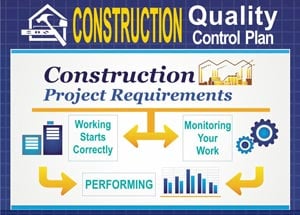
Now, not only do you need to produce quality, defect-free work, you also need to formally document your quality practices.

Explaining what you do and the specific ways you’ll carry out your quality practices on each project will become part of your project contract. It's no longer good enough to just say that you control quality.

Once only a requirement on government projects, I’m also seeing more and more quality plans required on non-government projects as well (although, it is still more common on government jobs).

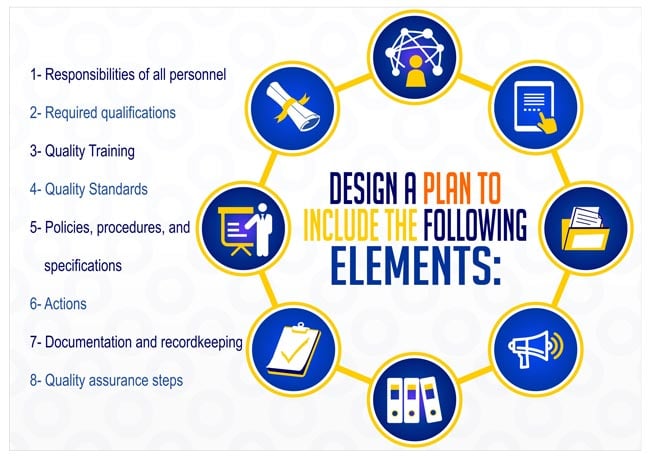
In any event, you'll want to be prepared to provide your clients with a well-formulated quality control plan including a quality manual, project plan, standard operating procedures and submittal forms.

Here's a short list of do's and don'ts based on some of the common mistakes I see with quality plan submittals.

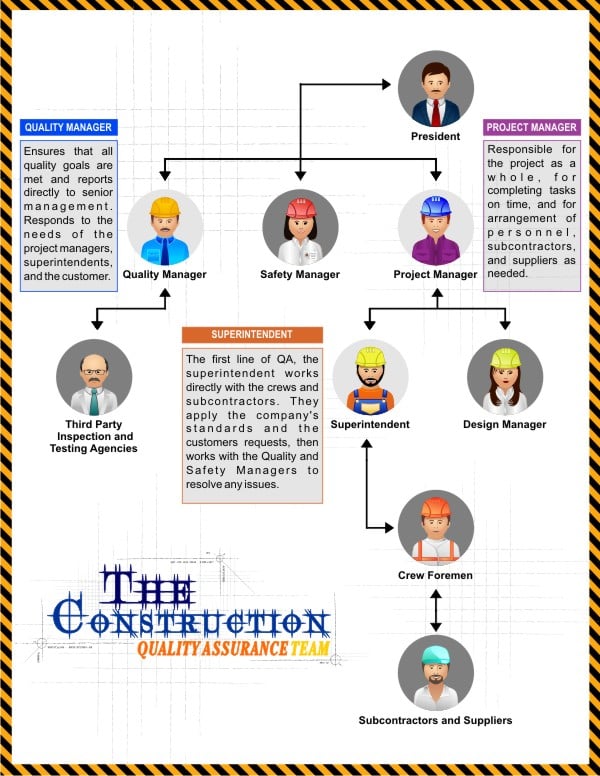
  1. Don’t appoint a superintendent as your quality manager. Clients want to see independence between the person who is responsible for the overall quality of your work and the person responsible for production.
  2. Do include a separate policy in your quality manual for the preparation of your project quality plan.
  3. Don’t forget to include local building codes in your quality plan. They apply even though your client may not have listed them in the contract specifications.
  4. Do provide a cross-reference table between your client’s requirements and your submittal. You need to make it easy for your client to see how you meet the contract specifications. This also makes it easy for you to cross check that you have addressed each required element in your contract specifications.
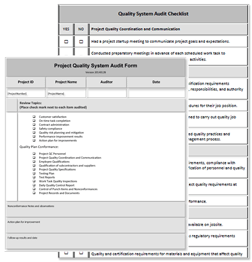
  5. Don’t forget to include a standard operating procedure for each submittal form. Often companies will have forms but not the accompanying procedures, which should include the purpose, scope, and references regarding the forms.
  6. Do look for quality-related specifications in all sections of your contract, even sections other than the QA/QC section. Quality-related requirements can be included throughout the contract.

The trend of requiring formal quality plans as part of construction contract submittals is here to stay. Whether you’re putting a quality plan submittal together now or will need one in the future, keep these tips in mind and you’ll avoid some of the more common problems.

~I'd appreciate hearing your thoughts. Please share your critique / approaches / feedback in comments below.

6 Tips to Simplify Your Construction Quality Control Plan

Submit to Digg digg it |  Add to delicious  delicious |  Submit to StumbleUpon StumbleUpon | Submit to Reddit reddit 

Simplified Construction Quality Control Plan Happy Worker ImageYou certainly don’t want to leave something out of your construction quality control plan that is needed or will get your plan rejected. On the other hand, you don’t want to add any unnecessary complexity either.
For starters, you’ll want to remove procedures that your client doesn’t actually require... And (more importantly) that you don’t intend to do.

Next, you’ll want to remove unnecessary detail in your quality control plan that can work against you.

Don’t get me wrong, I’m not saying you should try to get away with the bare minimum level of construction quality controls.

However, I am saying that you should consider the different levels of quality controls suitable for different projects and modify your construction quality control plan accordingly. The goal is to promise the right level of quality controls to make everyone happy -- you, your client, and your workers.

Whether you’re purchasing a construction quality control plan template or developing your plan from scratch, you’ll want to pay attention to these six Dos and Don’ts:
  1. Don’t say your Quality Manager performs ALL your inspections.

The role of your quality manager is to provide oversight and to validate that your quality processes are working. Construction superintendents will do most of your inspections. So, make sure to specify which inspections your quality manager will do and which ones your superintendents will do.

  1. Do customize the list of records you’ll keep based on each project’s requirements.

Some projects are short and simple, and therefore, don’t require a high level of record keeping. On the other hand, some projects do warrant detailed record keeping. You should modify your construction quality control plan to reflect the record keeping needs of each project.

  1. Don’t submit every form you own.

Here again, it’s important that you only submit the forms you need for each specific project. Otherwise, your client will expect you to carry out all the procedures connected with the forms you include in your quality control plan.

  1. Do limit the detail on your list of Quality Controlled Construction Tasks.

A good practice is to list all the phases of construction (i.e. definable features of work) where you do an inspection at the completion of the task. It’s not necessary to include all the phases of construction that are on your project schedule.

  1. Don’t add too much detail to your inspection forms.

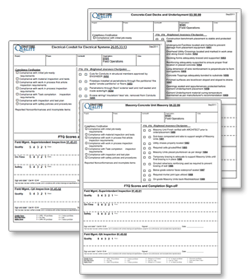
Inspection forms are for recording the completion of inspections. They’re records that the inspections took place, not records of your quality control standards. A good practice is to include about a dozen of your most important checkpoints, not a long list of minor construction details. Adding too many checkpoints can complicate matters for you.

  1. Don’t address each punch item as a nonconformance.

Most punch items are work in process corrections and not nonconformances. They’re easily corrected and don’t require the same level of quality controls as nonconformances. Your quality manual should differentiate work in process corrections from nonconformances. I suggest you handle items as nonconformances if they meet BOTH of these criteria: (a) items that do not meet project quality standards; and (b) only items remaining after the final task inspection has been completed.

The key to managing costs and liabilities is to provide the appropriate level of quality controls for each project. Your quality control plan is an extension of your contract and thus, a legally binding document. Promise too little and your client won’t be happy. Promise too much and you won’t be happy. Promise just the right amount and everyone is happy.

What is your approach to simplifying your construction quality control plan?

Please share your critique / approaches / feedback in comments below.

5 Things Construction Superintendents Can Do Reduce Punch Lists

Submit to Digg digg it |  Add to delicious  delicious |  Submit to StumbleUpon StumbleUpon | Submit to Reddit reddit 

Construction Quality PunchlistThere is no reason for your superintendents to continue to act as the subcontractors’ quality control inspector and creator of punchlists.

Here are 5 things superintendents can do to reduce punchlists and improve subcontractor quality performance.

#1 Communicate Expectations

Superintendents that set high expectations for first time quality ON THEIR JOBSITE get the best performance from their subcontractors.

Successful superintendents constantly reinforce their quality standards during production meetings and conversations. They make it clear, “Deliver 100% first time quality – don’t depend on me to create your punch lists!”

#2 Recognize Positive Behaviors

Everyone appreciates a bit of positive recognition. Subcontractors are no different. Even though you pay them to do a quality job, subcontractors will go the extra mile if they think you appreciate their extra effort. 

For other subcontractors whose performance varies, catch them when they do well and use the opportunity to recognize them.  Remember, behaviors that are recognized get repeated.

#3 Mentor and Teach

Teach your subcontractor to inspect their own work and punch it out before calling you to inspect.  Ask the subcontractor to be with you while you do your inspection. The result will surely be a reduced number of punch items.

#4 The Last Resort

If communicating expectations, and recognizing efforts, coupled with guided improvement does not work, ask the owner for an action plan that will address the issue of repeated punch items.

Follow-up diligently and adjust the plan until the issues are resolved.

#5 Measure Success

Make your team’s progress come alive. Use inspection scores or punch item count data to track overall progress. Share it with your subcontractors.

The best superintendents go on to ask their subcontractors, “how good can we get?” and involve them in developing a plan to make it happen.

In Conclusion

Field superintendents that follow this proactive partnering approach will see positive results. In other words, punch lists will be shorter, and you will have fewer problems.

Just make it clear that delivering 100% complete first time quality work -- without depending on superintendents for punchlists is your subcontractor’s responsibility.

5 Steps for Improving Your Construction Quality Standards

Submit to Digg digg it |  Add to delicious  delicious |  Submit to StumbleUpon StumbleUpon | Submit to Reddit reddit 

Construction Quality StandardsAsk any superintendent or subcontractor and they’ll tell you they install products the right way. After all, they’ve been in construction a long time, right?

This may surprise many of you, but almost every time I compare the manufacturer’s installation instructions with how a product was installed or built on the jobsite I find major differences.

If you don’t believe me, look closely at any critical building product installation. Take windows for example, bring the manufacturer’s instructions to your jobsite and compare the jobsite installation for flashings, sealants, shimming, and fastening, etc. with the manufacturer’s specifications.

Chances are, you’ll see that there’s a difference. It’s important for you to find these errors before they turn into costly defects or legal actions.

Here are five steps to making sure you are building it right.

1. Get the Specifications
First, you’ll need to know how to build it right. With most specifications on the internet, you can easily find product installation specifications on the manufacturer’s website. Also, review building code and industry standards.

2. Jobsite Verification
Second, observe an installation and compare what you see to the specifications. When you find a discrepancy, take pictures of details so you can refer to them later.

3. Define the Right Way
Third, if there is a discrepancy, ask the installer why they use the method they do. Not all differences mean that the installation is wrong. Your installer’s method might be better. Show them the specification and ask for their opinion.

Call the product manufacturer if you need additional insights. In the end, you will decide what the right way is for your company. If necessary, obtain a letter from your engineer or product manufacturer approving your alternative method.

Construction Quality Standards Training Sheet4. Train, Train, Train
When you find a product that’s not being installed correctly, create a hotspot training sheet for each detail showing the right way and the old (wrong) way. Train the installation crews, their supervisor, your field supervision staff, and quality personnel on the needed changes.

Reinforce the training by posting the training sheet on the jobsite and reviewing it with the crew before they begin work.

Inspection Form Hotspot Sheet5. Follow-up
Use your normal inspection process and field reviews for follow-up. Existing inspection forms can be used with this one simple enhancement: add a checkpoint for each revised installation detail. Even better is including reduced-sized training pictures on the inspection form.

If inspections find old ways persisting, loop back and retrain people that need special attention.

Getting Started
With the so many building products being installed, you’ll want to take a systematic approach to evaluating each one. My advice is to organize your effort by specialty trade. Start with the exterior building envelope, then proceed to concrete, and the mechanical trades. Allow yourself the flexibility to start the next trade as you get into step 3 or 4 above.

On some trades you can leverage your effort by asking some of your top people or subcontractors to take the lead. The good news is that in a few months you will make huge gains toward first time quality and minimize your risk for costly defects.

All Posts