Posted by Ed Caldeira on Tue, Mar 02, 2010 @ 07:55 AM
A project quality plan is a written plan that details how you will manage quality on a specific construction project.
This is different from a quality manual, which explains your quality policies and procedures in general, but not with information specific to each project.
Clients may ask for project quality plans in different ways. One way may be that your contract says you need to submit a quality control plan. Another way may be that your client comes out and asks for a project quality plan.
In most cases, everyone wants the same thing: your quality manual, standard operating procedures, and the project plan.
Below is a list of questions your project plan should answer. Underneath each question, I’ve listed the form(s) you can include in your plan on which to give your answers (i.e. the information your client wants).
Project Quality Plan
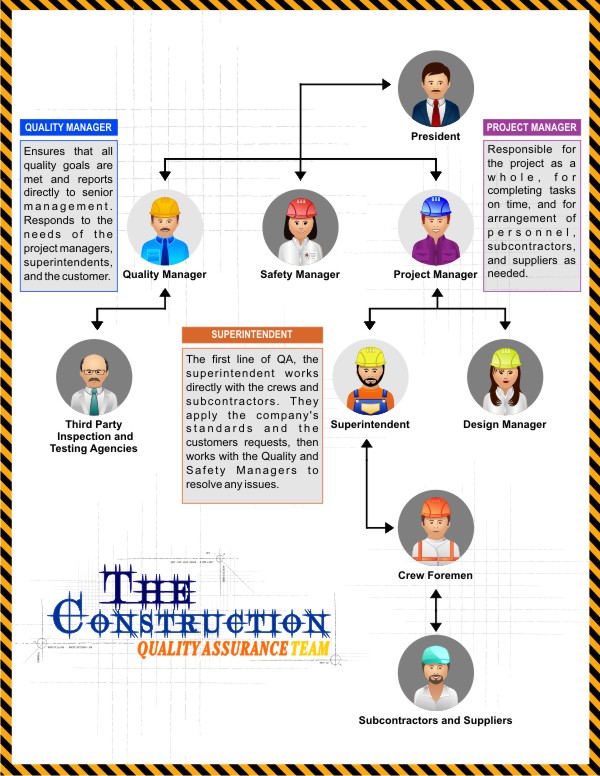
Who’s on the project quality management team?
- A Project Organization Chart
What makes them qualified to be there?
- Appointment Letters defining the responsibility and authority for each team member’s position
- Personnel Qualification Form verifying the capabilities of each team member and who approved them
- Resume for each team member
What training will you provide to make sure your people have the necessary skills and knowledge for this project? Will you train your customer on operations and maintenance? This should include quality system, quality procedures, and the technical training.
- Training Plan indicating the training and who has received it
Who are the points of contact for the project?
How will you make sure all quality-related information gets to the people that need it?
- Project Quality Communications Plan
What documents, reports, and records will you submit, by when, and to whom?
- Project Submittals Schedule and Log
Project-Specific Standards
What regulatory codes and industry standards apply to this project?
- Project Regulatory Codes and Industry Standards Form
Project-Specific Inspections and Tests
What inspections and tests will you conduct for this project? How will you record each inspection and test?
- Inspection and Test Plan Form
- Quality Controlled Construction Task Form
What measuring devices need calibration and how often?
- Measuring Devices Calibration Form
Project Purchasing
What credential and resources do your key subcontractors need such as licenses, insurance, production capacity? Also, how do their quality programs meet your requirements?
- Subcontractor and Supplier Qualification Form
Who are your qualified suppliers and what materials will they supply?

Download 2 Free Project Quality Plan forms:
1. Project Quality Plan Form (to use as a checklist for your quality plan submittal)
2. Quality Manager Appointment Form (to appoint your quality manager and assign quality responsibilities and authority)
Posted by Ed Caldeira on Sun, Feb 07, 2010 @ 10:20 AM
No sense reinventing the wheel... Using a template is a good starting point to develop your quality control plan.
But... it's not good practice to buy a template and just stick your name on it.
Your quality control plan should describe your quality methods, policies, and practices.
Here are some tips for customizing a template to your specific company QA/QC program.
1. Find a quality control plan template that has all the components you need including:
- Quality Manual
- Standard Operating Procedures
- Submittal Forms
2. Change general information into company-specific information.
Most quality manual templates use vague generalities to describe quality methods and policies. Below is an example of typical template wording that's vague, without specific detail.
|
All employees have the responsibility and authority for implementation of established QA/QC activities ... to:
- Initiate action to prevent the occurrence of work or service non-conformity;
- Identify and record any quality problems;
- Initiate, recommend, or provide solutions through designated channels;
- Verify the implementation of solutions;
- Control further processing, delivery, or installation of non-conforming work until the deficiency or unsatisfactory condition has been corrected.
|
Did you notice the general term "all employees"? I’d be very surprised if “all employees” in your company have the same quality responsibilities and authority.
So, change your template to include specific information about all key positions responsible for making sure that jobs are done right -- quality.
The example below shows clearly defined information for one such key position, the superintendent.
|
Caldeira Construction superintendents verify that work performed by subcontractors and Caldeira Construction work crews conforms to Caldeira Construction quality standards.
Caldeira Construction superintendents have specific responsibilities for:
- Ensuring that construction meets government regulatory and code requirements, customer requirements, contract requirements, contract technical specifications, contract drawings, approved contract submittals, and company quality standards and specifications
- Ensuring that subcontractors begin work in accordance with Excel Construction start-work policies
- Ensuring that subcontractors receive a notice to work only when conditions will not adversely affect quality results
- Conducting inspections, tests, and recording findings
- Accurately assessing subcontractor quality and on-time performance
- Ensuring that quality standards are achieved before approving subcontractor or work crew completion of work
Caldeira Construction superintendents have the authority to:
- Stop work when continuing work may adversely affect quality or cover up a defect
- Prevent the use of materials that may adversely affect quality
- Direct the removal or replacement of any non-conforming work or material
- Suspend work and/or supply of materials as deemed necessary to assure quality results
|
3. Add details
Take the time to include details. Here is another typical template example of vague wording without specific detail.
|
The Project Manager shall establish and maintain procedures to ensure that any work that does not conform to specified requirements is prevented from inadvertent release to the client. |
What procedures? After reading this example, will your client and company personnel know your nonconformance policy?
Here is an example that provides the needed detail.
|
When Caldeira Construction superintendents or inspectors identify nonconformances, they quickly mark the nonconformances with Caldeira Construction nonconformance tags to prevent inadvertent cover-ups. |
In Conclusion
Evaluate several different quality control plan templates and choose the one that has the most detail. After all, the less you have to “reinvent the wheel” the better.
Thoroughly read over the document, and tailor it to include your company's quality methods and policies.
Change vague, generalities to company-specific information, and add details.
Need a quality plan?
We offer comprehensive quality plan templates tailored to meet your company and project requirements. No need to reinvent the wheel!
Posted by Ed Caldeira on Fri, Jan 22, 2010 @ 04:13 PM
If you want a shot at winning a government construction contract, you'll want to dive in and tackle the mound of documents you'll need for your comprehensive quality control plan.
Quality control plans for government contracts require a substantial collection of documents, records, and forms. Their purpose is to communicate what you do to assure consistent quality results on every job.
A good quality control plan will show your clients that your company can fit into their quality systems.
What documents do you need?Most government agencies with comprehensive QA/QC requirements want specific submittals during each phase of construction. The phases include:
- Bid Qualification Phase
- Pre-Construction Phase
- Construction Phase
Here is a list of most of the documents or submittals you'll need for each phase of construction.
Bid Qualification Phase Submittal Documents - qualify your company to manage and deliver quality work
Pre-Construction Phase Submittal Documents -part of your project quality plan-- detail how you will manage and deliver quality on this project.
- Organization Chart – identifies the management team responsible for ensuring project quality
- Quality Personnel’s Qualifications form – lists the qualifications of your quality management team
- Quality Personnel’s Appointment letter– gives your quality management team authority for ensuring project quality
- Quality Training Plan – establishes your training plan for quality-related activities
- Regulatory codes and standards form - lists the regulatory codes and standards you comply with
- Industry standards form – outlines the industry standards you comply with
- Inspection and Test Plan form– describes the inspections and tests you conduct
- Selection of key suppliers and subcontractors form – explains you supplier and subcontractor selection process
- Material and equipment specification form – records specifications for the material and equipment you use
- Communications plan form - records a summary of monthly project status reports
Construction Phase Submittal Documents - provide a record of how you carried out your project quality plan
- Inspection and Test Records – records the results from your planned inspections and tests
- Nonconformance Reporting – documents any work or materials found during inspections and tests that don’t meet (conform to) your standards
- Daily Construction Reporting – summarizes what happened on the job site that day
- Training Records – lists training sessions that were conducted for preventive as well as improvement purposes
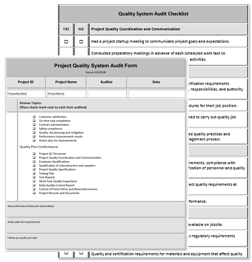
- Quality System Audits – defines the preventive actions you take because of your monthly project quality system audits and your annual company-wide quality system audit.
- Document Control Records – explains the controls you use to keep your quality system records up-to-date, accurate, and safe
The way you show your client that you have a good QA/QC program with good systems in place is by showing them your system documentation. In other words, you need to show them a good quality control plan.
Get started with developing your quality control plan by documenting the quality processes you do now.
Follow that up with a plan to improve upon your existing quality systems, and you'll be ready for that government construction contract.
And, don't forget... always document your quality processes.
Posted by Ed Caldeira on Sun, Jan 10, 2010 @ 10:08 PM
This is the first in a series designed for general contractors to take some of the frustration out of understanding your client’s quality assurance and quality control plan requirements.
It's also intended to help you develop a quality plan to meet those requirements.
Here are a few steps to follow:
1. Identify all the quality requirements within your contract
There's usually a quality assurance specifications section in your contract. That's where most of your quality requirements will be.
Also check other sections for “quality assurance” and “submittals” subheadings where your client may list additional requirements. These requirements will be a combination of project-specific, client-specific and industry standard requirements.
2. Know which construction industry quality standards you need to address
There are two widely used construction industry standards for quality:
You can download a copy of the USACE and FTA standards from our website by clicking on the links above.
Both of these construction industry standards are variations of ISO9000 quality standards.
3. Make an action items list of your requirements
Since most contract specifications are in paragraph or narrative form, it will be helpful to break the requirements down into an actionable list. Hint: Just look for the action verbs.
Below, I’ve highlighted action items by their action verb in FTA industry standard - Element 1: Management Responsibility
“... Management should designate a representative who shall have defined authority and responsibility for ensuring that the quality policy is implemented and maintained. Management should also identify those persons responsible for the quality assurance function and should define in writing the responsibility, authority, and interrelation of those persons.”
4. Create a Cross-Reference Table or Checklist for Each RequirementNext, cross-reference the sections of your quality plan that meet your contract requirements with the requirements you've identified.
This will help you keep all of your contract requirements straight and make sure you address each one in your quality plan submittal.
To see a cross-reference tables of how our quality plans conform to the FTA and USACE requirements, click on the following links:
Cross-Reference Table - FTA Quality Assurance Quality Control Guidelines
Cross-Reference Table - USACE Quality Control Requirements
For some more examples of quality manual, project plan and SOPs that meet contract requirements, look at the Table of Contents and some sample pages from our quality plans.
Need help figuring out your contract requirements or developing your construction quality plan submittal?
Contact me for a free contract specifications review.
Posted by Ed Caldeira on Wed, Dec 16, 2009 @ 02:04 PM
Every quality driven construction company needs a written QA/QC Framework. Your QA/QC Framework will act as your company standard for setting and establishing quality-related activities across all divisions and projects.
Even if you already have a written set of policies and procedures, your QA/QC framework will help put those details into perspective as part of a well thought out, integrated quality system.
Your QA/QC Framework should be a simple two or three page document, easily understandable by customers, employees, and subcontractors, and one that describes what your company does to manage quality.
This powerful yet simple document only describes WHAT your company does to assure quality and not HOW your company does it. The HOW details should be included in your policies and procedures document.
I recommend that every construction company’s QA/QC Framework include at least six elements. The following are six elements you should include in your QA/QC Framework:
1. Quality Organization and Management
2. Documented Standards and Specifications
3. Formal Qualifications of Employees
4. Formal Qualifications of Subcontractors and Suppliers
5. Documented Field Inspections
6. Control and Prevention of Nonconformances
Each element should have a statement paragraph and several bullet points that define the company's standards. Here is a good example of a statement paragraph and bullet points for Framework element #5, Documented Field Inspections.
#5 Documented Field Inspections
[Company Name] inspection processes ensure that all construction activities comply with the documented standards and specifications. We:
- Develop an inspection and test plan to identify required inspections and tests at key milestones during the construction, closeout, and warranty.
- Conduct a series of inspections for each construction task; before work begins, at first article completion, while work is in process, and at completion.
- Identify required checkpoints for critical quality and safety requirements for each construction task inspection.
- Use third party inspectors to verify conformance to critical quality and safety standards when a re-inspection cannot be repeated at job completion. The needs of the project dictate the frequency of third party inspections.
Each division or project typically has its own separate QA/QC manual that defines how the division or project carries out its quality-related activities. This allows for flexibility within divisions and projects, but provides consistency within the company.
In Conclusion
Think of your QA/QC framework as the backbone of your company’s quality program. Once you’ve developed the structure, you are then ready to build on the details. Preparing detailed QA/QC manuals for company divisions and Quality Plans for specific contracts becomes much easier.
The Framework is a tool for communicating your quality approach to customers and subcontractors outside your company as well as people inside the company. In most cases, the Framework will be useful for bid qualifications when owners ask for a brief description of your quality control methods.
More QA/QC Framework Examples.

Download a free sample of selected sections from our custom QA/QC Framework along with sections from our comprehensive quality plan.
Posted by Ed Caldeira on Fri, Dec 11, 2009 @ 08:16 AM
Starting a Hotspot Process

If you are finding the same quality issues week after week, and checking boxes on inspection forms has become just a routine, it's time to start a 'Hotspot' process.
Implementing a Hotspot process involves identifying current quality issues, setting up training, adding Hotspot checkpoints to your inspection forms, and paying close attention to Hotspot problems during inspections.
- Identify one to two quality issues (per trade) to work on. Have your area or project supervisors identify one to two quality issues (per trade) through job inspections, comprehensive quality reviews, and builder feedback.
- Add these as checkpoints. Include these top quality issues as Hotspot checkpoints on your inspection forms.
- Create one-page training sheets. Using pictures and diagrams to address each specific problem create one-page Hotspot training sheets.
- Train production personnel and subcontractors. During weekly production meetings or toolbox talks, train production personnel and subcontractors on procedures to eliminate the newly identified Hotspot problems.
- Post the Hotspot training sheets in a prominent area.
- Finally, celebrate successes. When your supervisors declare the end to an existing Hotspot issue, post the item in the production meeting room as a quality success.
Remove the checkpoint from the Hotspot part of the
inspection form and put it in the reminder section.
Set a goal of replacing one to two Hotspot checkpoints per trade, per month. Of course, if the problem is not under control, don’t add a new Hotspot checkpoint in its place. Some problems may take longer than one month to eliminate.
Change the Hotspot checkpoints on your inspection forms as needed, bringing attention to current issues that demand a response from field personnel. The forms should also list key specifications, but only as reminders.
Subcontractors and superintendents should always pay close attention to Hotspots when inspecting every job.
Posted by Ed Caldeira on Wed, Dec 09, 2009 @ 09:06 PM
There is no reason for your superintendents to continue to act as the subcontractors’ quality control inspector and creator of punchlists.
Here are 5 things superintendents can do to reduce punchlists and improve subcontractor quality performance.
#1 Communicate Expectations
Superintendents that set high expectations for first time quality ON THEIR JOBSITE get the best performance from their subcontractors.
Successful superintendents constantly reinforce their quality standards during production meetings and conversations. They make it clear, “Deliver 100% first time quality – don’t depend on me to create your punch lists!”
#2 Recognize Positive Behaviors
Everyone appreciates a bit of positive recognition. Subcontractors are no different. Even though you pay them to do a quality job, subcontractors will go the extra mile if they think you appreciate their extra effort.
For other subcontractors whose performance varies, catch them when they do well and use the opportunity to recognize them. Remember, behaviors that are recognized get repeated.
#3 Mentor and Teach
Teach your subcontractor to inspect their own work and punch it out before calling you to inspect. Ask the subcontractor to be with you while you do your inspection. The result will surely be a reduced number of punch items.
#4 The Last Resort
If communicating expectations, and recognizing efforts, coupled with guided improvement does not work, ask the owner for an action plan that will address the issue of repeated punch items.
Follow-up diligently and adjust the plan until the issues are resolved.
#5 Measure Success
Make your team’s progress come alive. Use inspection scores or punch item count data to track overall progress. Share it with your subcontractors.
The best superintendents go on to ask their subcontractors, “how good can we get?” and involve them in developing a plan to make it happen.
In Conclusion
Field superintendents that follow this proactive partnering approach will see positive results. In other words, punch lists will be shorter, and you will have fewer problems.
Just make it clear that delivering 100% complete first time quality work -- without depending on superintendents for punchlists is your subcontractor’s responsibility.
Posted by Ed Caldeira on Wed, Dec 09, 2009 @ 08:20 AM
Quality is subjective. That's why it's important that everyone in your organization use the same guidelines for measuring it.
When doing an inspection, I suggest you measure the level of avoidable problems you encounter and rate them using a rating scale of 1 to 5:
5 = Perfect, no problems, 100%
4 = Very good, 1-2 minor problems
3 = Good, 3-5 minor problems
2 = Poor, 6+ minor problems, hotspot or a major problem
1 = Very poor, excessive problems
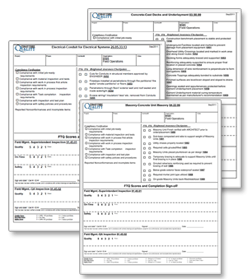
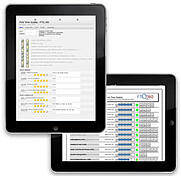
Use your First Time Quality construction inspection forms to record your ratings and make sure to include notes for any measurements under a 5.
Adding notes and comments is a good way to give feedback to the subcontractor or crew whose work you are measuring.
Constructive feedback will encourage subcontractors and crews to make improvements to their work, while positive feedback for a job well done will encourage more of the same top quality work.
Comments might include:
- "Overspray on floors,"
- "Outlets covered by drywall,"
- "Concrete not level."
- "Great Job!,"
- "No Problems,"
Strongly encourage your superintendents to give accurate quality measurements. Afer all, it will be difficult to measure improvements if superintendents give inflated scores.
Make sure everyone knows that the purpose of measuring is to gauge the current level of quality and to work together towards improving it.
Remember keep your quality management process simple, consistent, and a positive team effort.
Posted by Ed Caldeira on Mon, Dec 07, 2009 @ 12:37 PM
Ask any superintendent or subcontractor and they’ll tell you they install products the right way. After all, they’ve been in construction a long time, right?
This may surprise many of you, but almost every time I compare the manufacturer’s installation instructions with how a product was installed or built on the jobsite I find major differences.
If you don’t believe me, look closely at any critical building product installation. Take windows for example, bring the manufacturer’s instructions to your jobsite and compare the jobsite installation for flashings, sealants, shimming, and fastening, etc. with the manufacturer’s specifications.
Chances are, you’ll see that there’s a difference. It’s important for you to find these errors before they turn into costly defects or legal actions.
Here are five steps to making sure you are building it right.
1. Get the Specifications
First, you’ll need to know how to build it right. With most specifications on the internet, you can easily find product installation specifications on the manufacturer’s website. Also, review building code and industry standards.
2. Jobsite Verification
Second, observe an installation and compare what you see to the specifications. When you find a discrepancy, take pictures of details so you can refer to them later.
3. Define the Right Way
Third, if there is a discrepancy, ask the installer why they use the method they do. Not all differences mean that the installation is wrong. Your installer’s method might be better. Show them the specification and ask for their opinion.
Call the product manufacturer if you need additional insights. In the end, you will decide what the right way is for your company. If necessary, obtain a letter from your engineer or product manufacturer approving your alternative method.
4. Train, Train, Train
When you find a product that’s not being installed correctly, create a hotspot training sheet for each detail showing the right way and the old (wrong) way. Train the installation crews, their supervisor, your field supervision staff, and quality personnel on the needed changes.
Reinforce the training by posting the training sheet on the jobsite and reviewing it with the crew before they begin work.
5. Follow-up
Use your normal inspection process and field reviews for follow-up. Existing inspection forms can be used with this one simple enhancement: add a checkpoint for each revised installation detail. Even better is including reduced-sized training pictures on the inspection form.
If inspections find old ways persisting, loop back and retrain people that need special attention.
Getting Started
With the so many building products being installed, you’ll want to take a systematic approach to evaluating each one. My advice is to organize your effort by specialty trade. Start with the exterior building envelope, then proceed to concrete, and the mechanical trades. Allow yourself the flexibility to start the next trade as you get into step 3 or 4 above.
On some trades you can leverage your effort by asking some of your top people or subcontractors to take the lead. The good news is that in a few months you will make huge gains toward first time quality and minimize your risk for costly defects.