Subscribe by Email

Your email:


Download Quality Control Plans


blogarama - the blog directory

Blog Directory

Bloglisting.net - The internets fastest growing blog directory

Caldeira Quality's Construction QA/QC Blog

Current Articles | RSS Feed RSS Feed

Understanding USACE and NAVFAC Definable Features of Work

Submit to Digg digg it |  Add to delicious  delicious |  Submit to StumbleUpon StumbleUpon | Submit to Reddit reddit 
USACE Definable Features of Work

For all U.S. Army Corps of Engineers (USACE) and Naval Facilities (NAVFAC) Government projects, you’ll need to provide a list of your Definable Features of Work as part of your contractor quality control plan.

If you’re not already familiar with the term, Definable Features of Work (DFOW) are what you might think of as construction tasks or phases of construction.

The Corps of Engineers describes a DFOW as a task that is separate and distinct from other tasks and has control requirements and work crews unique to that task. A DFOW is identified by different trades or disciplines and is an item or activity on the construction schedule.1 So, for example, excavation, electrical, concrete, roofing, mechanical, HVAC, etc. are all Definable Features of Work.
 
When it comes to deciding on your DFOW, you’ll want to define your features narrowly enough to ensure adequate quality controls, yet, not so narrowly that you cause yourself a lot of unnecessary work.

Keep in mind that for each definable feature, you’ll be required to perform the Three Phases of Control, which means you’ll be performing a series of planning, inspection, and record keeping procedures for each.

The following steps will help you find the right balance for your Definable Features of Work. 

Step One

Start by including one DFOW for each specification in the CSI construction specifications section of your contract e.g. 03 30 00 Cast-In-Place Concrete.

For example, each Blue Check Markchecked line item below should be a separate Definable Feature of Work.

USACE Spec

Step Two

Next, add to or replace general category tasks with tasks that meet the following criteria:

  • It requires quality controls such as inspections
  • It has trades, work crews, or disciplines unique to that task
  • It is a critical path activity on the schedule
  • It is monitored by a QC Specialist or specialty inspection personnel

For Example, in place of the general category Cast-In-Place Concrete, you would add the following to your DFOW list:

Blue Check MarkConcrete Form Work and Placing Reinforcement

Blue Check MarkPlacing Concrete, Finishing, and Curing

 By following these steps, the process of deciding on your definable features of work will become much more clear-cut and straightforward. As with most things, experience makes the best teacher.


1 USACE-NAVFAC-AFCESA-NASA_Quality_Control_Requirements_UFGS-01_45_02.pdf

How to Avoid Problems with Your Construction Quality Control Plan

Submit to Digg digg it |  Add to delicious  delicious |  Submit to StumbleUpon StumbleUpon | Submit to Reddit reddit 

how to avoid problems with your construction quality control plan submittalAs a construction quality consultant, one trend I’m seeing is that more project owners are asking for construction quality control plans. And, it’s clear that this practice is increasing.
Now, not only do you need to produce quality, defect-free work, you also need to formally document your quality practices.

Explaining what you do and the specific ways you’ll carry out your quality practices on each project will become part of your project contract. It's no longer good enough to just say that you control quality.

Once only a requirement on government projects, I’m also seeing more and more quality plans required on non-government projects as well (although, it is still more common on government jobs).

In any event, you'll want to be prepared to provide your clients with a well-formulated quality control plan including a quality manual, project plan, standard operating procedures and submittal forms.

Here's a short list of do's and don'ts based on some of the common mistakes I see with quality plan submittals.

  1. Don’t appoint a superintendent as your quality manager. Clients want to see independence between the person who is responsible for the overall quality of your work and the person responsible for production.
  2. Do include a separate policy in your quality manual for the preparation of your project quality plan.
  3. Don’t forget to include local building codes in your quality plan. They apply even though your client may not have listed them in the contract specifications.
  4. Do provide a cross-reference table between your client’s requirements and your submittal. You need to make it easy for your client to see how you meet the contract specifications. This also makes it easy for you to cross check that you have addressed each required element in your contract specifications.
  5. Don’t forget to include a standard operating procedure for each submittal form. Often companies will have forms but not the accompanying procedures, which should include the purpose, scope, and references regarding the forms.
  6. Do look for quality-related specifications in all sections of your contract, even sections other than the QA/QC section. Quality-related requirements can be included throughout the contract.

The trend of requiring formal quality plans as part of construction contract submittals is here to stay. Whether you’re putting a quality plan submittal together now or will need one in the future, keep these tips in mind and you’ll avoid some of the more common problems.

~I'd appreciate hearing your thoughts. Please share your critique / approaches / feedback in comments below.

Construction Quality Management: The Franchise Approach

Submit to Digg digg it |  Add to delicious  delicious |  Submit to StumbleUpon StumbleUpon | Submit to Reddit reddit 

Consistent Construction Quality Management ImageOne of the most common problems I find with construction quality management is a lack of consistency from project to project.

It’s not that organizations don’t have quality management systems in place.

It’s that, oftentimes, there's no consistency in terms of how they approach quality from one project to the next or even from one superintendent to the next.  Like franchises, you want all your projects to maintain consistent quality.

Take McDonald’s for instance, whether you like the brand (or the food) or not, you have to agree that as a franchise, the company is very successful. Why?   Umm...because the food is cheap?  While this is certainly true, it’s not the reason for McDonald’s success.

Consistency... just about every McDonald's has the same basic layout, menu, ordering process, and quality of food.  All this standardization creates consistency for the customer, for the employees, and for the franchise owners – all with an unskilled workforce. And, it’s a consistency that’s based on what works.

The same consistent quality should apply to construction quality management in your organization. Keep in mind, most people at your organization are busy dealing with their normal workload, plus the inevitable firefighting that crops up on a regular basis. 

In our fast-paced world of construction, work procedures have to make sense in a hurry, or they'll just go by the wayside. You can't expect people to always figure out things on the fly. You need some standardization so you can have consistent quality management.

Some companies may have a single, unifying quality policy for the entire organization, but may not implement it the same from one project to the next. For example, if you leave it up to each project manager to re-invent the wheel on every project, you’ll sacrifice consistent construction quality.

A much more effective approach would be to create a company-wide quality management system that you can use on all projects.  Such a system might include your quality policies in a quality assurance/quality control manual, project-specific quality plan, inspection procedures, quality improvement processes, and quality system analytics.  Having a standardized company-wide quality management system creates consistency across all projects. 

People working on multiple projects will perform the same procedures, and these procedures will become second-nature for them. This consistency makes it more likely that the procedures will actually be executed properly.

Keep in mind that these quality policies do not have to be overly prescriptive. You’re not trying to standardize every aspect of the work; you’re just trying to create a common framework for people to use to consistently manage quality.

Your framework should be flexible enough to be adapted to different projects and teams. On the other hand, your framework should definitely be standardized enough so that any employee plucked away from one project and dropped down into another project would quickly know what to do with regards to quality.

The goal is consistent quality. It’s your brand, how do you want to franchise it?

What is your approach to consistency with regard to construction quality management?

Please share your critique / approaches / feedback in comments below.

6 Tips for Eliminating Recurring Construction Defects

Submit to Digg digg it |  Add to delicious  delicious |  Submit to StumbleUpon StumbleUpon | Submit to Reddit reddit 
Starting a Hotspot Process

Hotspot Training SheetIf you are finding the same quality issues week after week, and checking boxes on inspection forms has become just a routine, it's time to start a 'Hotspot' process.

Implementing a Hotspot process involves identifying current quality issues, setting up training, adding Hotspot checkpoints to your inspection forms, and paying close attention to Hotspot problems during inspections.
  1. Identify one to two quality issues (per trade) to work on. Have your area or project supervisors identify one to two quality issues (per trade) through job inspections, comprehensive quality reviews, and builder feedback.
  2. Add these as checkpoints. Include these top quality issues as Hotspot checkpoints on your inspection forms.
  3. Create one-page training sheets. Using pictures and diagrams to address each specific problem create one-page Hotspot training sheets.
  4. Train production personnel and subcontractors. During weekly production meetings or toolbox talks, train production personnel and subcontractors on procedures to eliminate the newly identified Hotspot problems.
  5. Post the Hotspot training sheets in a prominent area.
  6. Finally, celebrate successes. When your supervisors declare the end to an existing Hotspot issue, post the item in the production meeting room as a quality success. 
Remove the checkpoint from the Hotspot part of the inspection form and put it in the reminder section.

Set a goal of replacing one to two Hotspot checkpoints per trade, per month. Of course, if the problem is not under control, don’t add a new Hotspot checkpoint in its place. Some problems may take longer than one month to eliminate.

Change the Hotspot checkpoints on your inspection forms as needed, bringing attention to current issues that demand a response from field personnel. The forms should also list key specifications, but only as reminders.

Subcontractors and superintendents should always pay close attention to Hotspots when inspecting every job.

5 Things Construction Superintendents Can Do Reduce Punch Lists

Submit to Digg digg it |  Add to delicious  delicious |  Submit to StumbleUpon StumbleUpon | Submit to Reddit reddit 

Construction Quality PunchlistThere is no reason for your superintendents to continue to act as the subcontractors’ quality control inspector and creator of punchlists.

Here are 5 things superintendents can do to reduce punchlists and improve subcontractor quality performance.

#1 Communicate Expectations

Superintendents that set high expectations for first time quality ON THEIR JOBSITE get the best performance from their subcontractors.

Successful superintendents constantly reinforce their quality standards during production meetings and conversations. They make it clear, “Deliver 100% first time quality – don’t depend on me to create your punch lists!”

#2 Recognize Positive Behaviors

Everyone appreciates a bit of positive recognition. Subcontractors are no different. Even though you pay them to do a quality job, subcontractors will go the extra mile if they think you appreciate their extra effort. 

For other subcontractors whose performance varies, catch them when they do well and use the opportunity to recognize them.  Remember, behaviors that are recognized get repeated.

#3 Mentor and Teach

Teach your subcontractor to inspect their own work and punch it out before calling you to inspect.  Ask the subcontractor to be with you while you do your inspection. The result will surely be a reduced number of punch items.

#4 The Last Resort

If communicating expectations, and recognizing efforts, coupled with guided improvement does not work, ask the owner for an action plan that will address the issue of repeated punch items.

Follow-up diligently and adjust the plan until the issues are resolved.

#5 Measure Success

Make your team’s progress come alive. Use inspection scores or punch item count data to track overall progress. Share it with your subcontractors.

The best superintendents go on to ask their subcontractors, “how good can we get?” and involve them in developing a plan to make it happen.

In Conclusion

Field superintendents that follow this proactive partnering approach will see positive results. In other words, punch lists will be shorter, and you will have fewer problems.

Just make it clear that delivering 100% complete first time quality work -- without depending on superintendents for punchlists is your subcontractor’s responsibility.

Measuring Construction Quality Using Inspection Forms

Submit to Digg digg it |  Add to delicious  delicious |  Submit to StumbleUpon StumbleUpon | Submit to Reddit reddit 

Quality is subjective. That's why it's important that everyone in your organization use the same guidelines for measuring it.

When doing an inspection, I suggest you measure the level of avoidable problems you encounter and rate them using a rating scale of 1 to 5:

5 = Perfect, no problems, 100%
4 = Very good, 1-2 minor problems
3 = Good, 3-5 minor problems
2 = Poor, 6+ minor problems, hotspot or a major problem
1 = Very poor, excessive problems

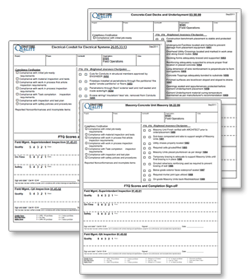
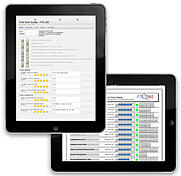
Inspection Checklist FormsUse your First Time Quality construction inspection forms to record your ratings and make sure to include notes for any measurements under a 5.

Adding notes and comments is a good way to give feedback to the subcontractor or crew whose work you are measuring.

Constructive feedback will encourage subcontractors and crews to make improvements to their work, while positive feedback for a job well done will encourage more of the same top quality work.

Comments might include:

- "Overspray on floors,"
- "Outlets covered by drywall,"
- "Concrete not level."
- "Great Job!,"
- "No Problems,"

Strongly encourage your superintendents to give accurate quality measurements. Afer all, it will be difficult to measure improvements if superintendents give inflated scores.

Make sure everyone knows that the purpose of measuring is to gauge the current level of quality and to work together towards improving it.

Remember keep your quality management process simple, consistent, and a positive team effort.

5 Steps for Improving Your Construction Quality Standards

Submit to Digg digg it |  Add to delicious  delicious |  Submit to StumbleUpon StumbleUpon | Submit to Reddit reddit 

Construction Quality StandardsAsk any superintendent or subcontractor and they’ll tell you they install products the right way. After all, they’ve been in construction a long time, right?

This may surprise many of you, but almost every time I compare the manufacturer’s installation instructions with how a product was installed or built on the jobsite I find major differences.

If you don’t believe me, look closely at any critical building product installation. Take windows for example, bring the manufacturer’s instructions to your jobsite and compare the jobsite installation for flashings, sealants, shimming, and fastening, etc. with the manufacturer’s specifications.

Chances are, you’ll see that there’s a difference. It’s important for you to find these errors before they turn into costly defects or legal actions.

Here are five steps to making sure you are building it right.

1. Get the Specifications
First, you’ll need to know how to build it right. With most specifications on the internet, you can easily find product installation specifications on the manufacturer’s website. Also, review building code and industry standards.

2. Jobsite Verification
Second, observe an installation and compare what you see to the specifications. When you find a discrepancy, take pictures of details so you can refer to them later.

3. Define the Right Way
Third, if there is a discrepancy, ask the installer why they use the method they do. Not all differences mean that the installation is wrong. Your installer’s method might be better. Show them the specification and ask for their opinion.

Call the product manufacturer if you need additional insights. In the end, you will decide what the right way is for your company. If necessary, obtain a letter from your engineer or product manufacturer approving your alternative method.

Construction Quality Standards Training Sheet4. Train, Train, Train
When you find a product that’s not being installed correctly, create a hotspot training sheet for each detail showing the right way and the old (wrong) way. Train the installation crews, their supervisor, your field supervision staff, and quality personnel on the needed changes.

Reinforce the training by posting the training sheet on the jobsite and reviewing it with the crew before they begin work.

Inspection Form Hotspot Sheet5. Follow-up
Use your normal inspection process and field reviews for follow-up. Existing inspection forms can be used with this one simple enhancement: add a checkpoint for each revised installation detail. Even better is including reduced-sized training pictures on the inspection form.

If inspections find old ways persisting, loop back and retrain people that need special attention.

Getting Started
With the so many building products being installed, you’ll want to take a systematic approach to evaluating each one. My advice is to organize your effort by specialty trade. Start with the exterior building envelope, then proceed to concrete, and the mechanical trades. Allow yourself the flexibility to start the next trade as you get into step 3 or 4 above.

On some trades you can leverage your effort by asking some of your top people or subcontractors to take the lead. The good news is that in a few months you will make huge gains toward first time quality and minimize your risk for costly defects.

All Posts